
VM-22, AG 55 and GOES: the 2026 rule changes for life and annuity actuaries
Principle-based annuity reserves, new economic scenarios, offshore reinsurance tests and Canada's model risk rule: what changed and what it means for hiring.
In short
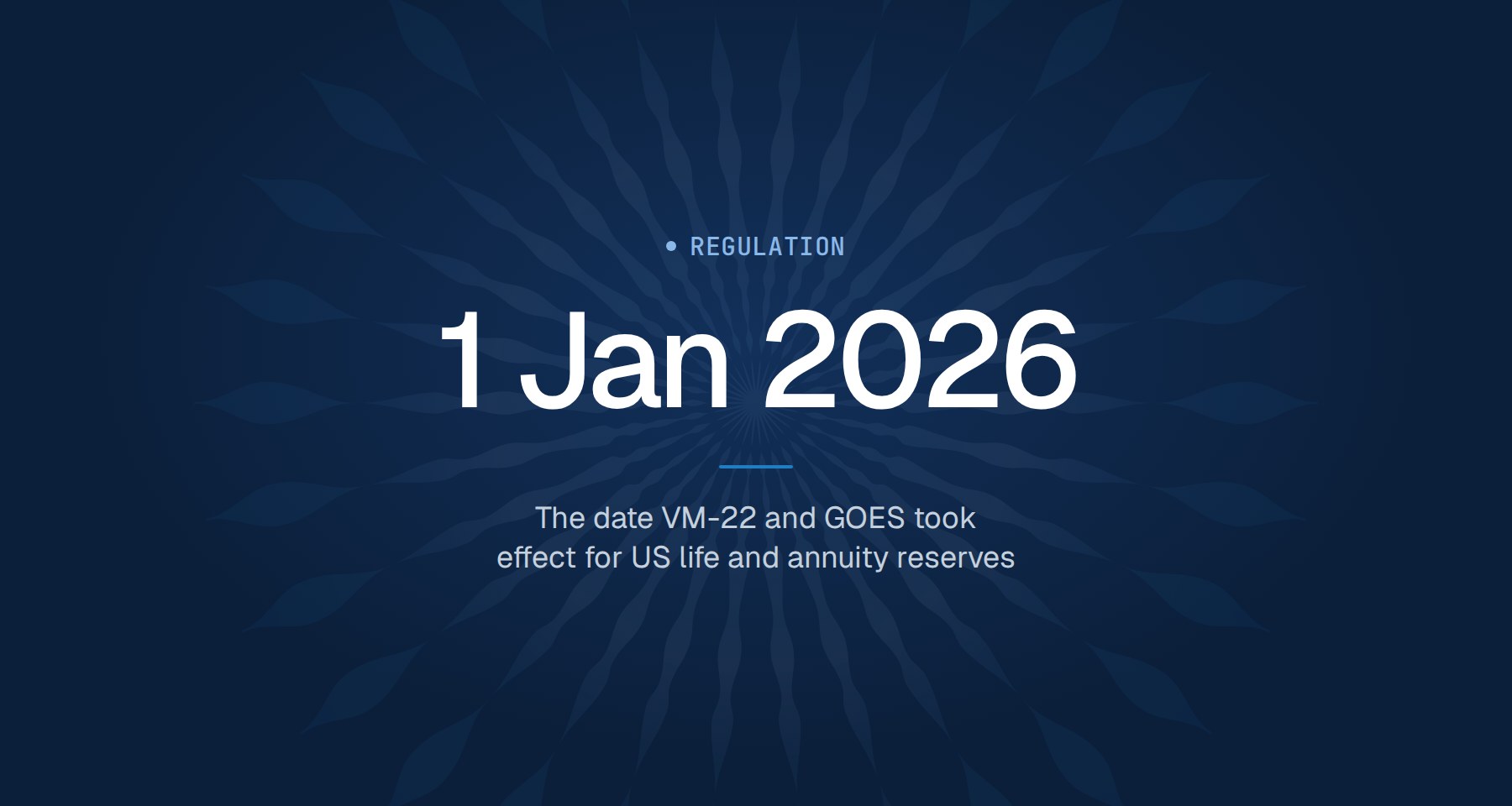
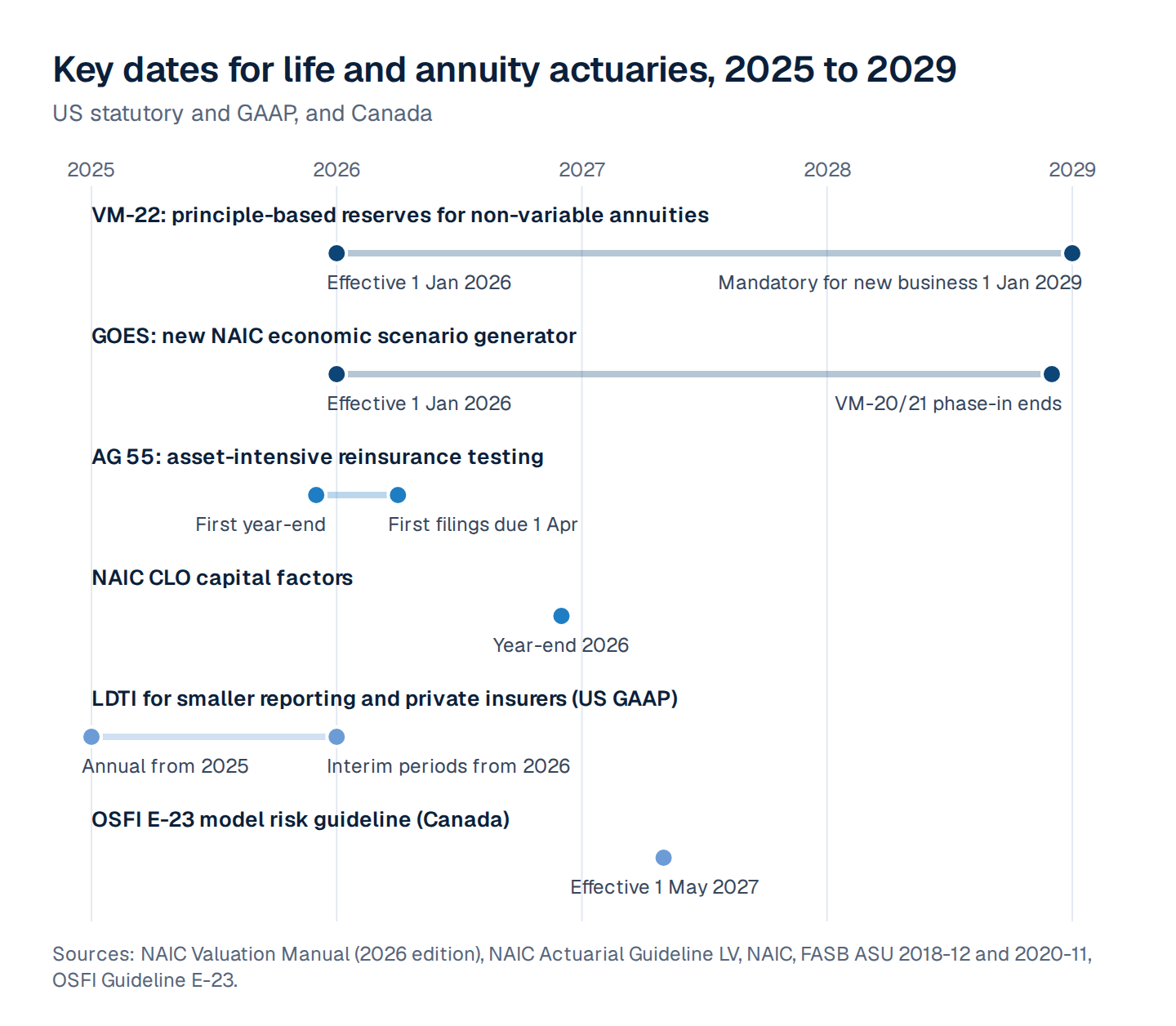
- VM-22 brings principle-based reserving to non-variable annuities. It applies from 1 January 2026 and becomes mandatory for new business from 1 January 2029.
- GOES, the NAIC's new economic scenario generator, replaced the Academy generator from 1 January 2026, with an optional 36-month phase-in for VM-20 and VM-21 reserves.
- AG 55 requires US insurers that cede large asset-intensive blocks to offshore or captive reinsurers to cash-flow test the reserves after reinsurance. The first filings landed in 2026.
- In Canada, OSFI's model risk guideline E-23 takes effect on 1 May 2027 and covers AI and machine learning models.
- These changes land in a record annuity market, and they are creating demand for valuation, modelling, ALM and model governance skills.
LDTI reshaped hiring for US GAAP reporting and IFRS 17 did the same in Canada. In 2026 the change is on the US statutory side. Here is what changed, when, and what it means for the people doing the work.
VM-22: principle-based reserving for annuities
The NAIC adopted the VM-22 framework in August 2025 as part of the 2026 Valuation Manual. It applies to non-variable annuities issued on or after 1 January 2026.
- Transition. For business issued in the first three years, companies can keep using the old formula reserves. Once a company adopts VM-22 for a type of business, it must keep applying it to future issues of that business. VM-22 becomes mandatory for new issues from 1 January 2029.
- Scope. Fixed deferred and fixed indexed annuities, payout annuities including SPIAs, DIAs, structured settlements and pension risk transfer, and longevity reinsurance. Preneed annuities, GICs, funding agreements and other stable value contracts are excluded. Companies with less than $1 billion of relevant reserves, in a group with less than $2 billion, can be exempt.
- Mechanics. The stochastic reserve is set at CTE 70. Blocks that pass the single scenario test can use a deterministic reserve, and blocks that pass the stochastic exclusion test can keep formula reserves. The standard projection amount is a disclosure, not a floor. An amendment in the 2027 Valuation Manual adds an attribution analysis on the additional standard projection amount every three years once the transition period ends.
- Still moving. Regulators are still deciding whether and how companies can elect VM-22 for business issued before 2026, with questions out for comment until 30 October 2026, and they have consulted on whether GICs and funding agreements should come into scope.
The consulting firms are clear about what this takes. Milliman calls asset modelling "a key driver of VM-22 results". PwC's list of implementation challenges includes assumption benchmarking, model validation, asset and reserve optimisation, and documentation, and it flags model run time as a lesson learned. EY suggests companies consider forming new teams or dedicated roles.
GOES: new economic scenarios
The NAIC also adopted a new Generator of Economic Scenarios, maintained by Conning, to replace the Academy Interest Rate Generator. It applies to VM-20, VM-21 and VM-22 from 1 January 2026. For VM-20 and VM-21 reserves, companies can choose to phase in its impact over 36 months. The NAIC has since extended GOES to C-3 Phase I and Phase II capital, effective for year-end 2026 (adopted by the Capital Adequacy Task Force in May 2026).
For modelling teams, this means new scenario sets, new validation work and new explanations for management about why reserves moved.
AG 55: testing asset-intensive reinsurance
Actuarial Guideline LV, known as AG 55, was adopted in August 2025. It applies to asset adequacy analysis from the 31 December 2025 annual statement.
- Who it covers. US insurers that have ceded asset-intensive business since 1 January 2016 to reinsurers that do not file US-style actuarial memoranda, where the business ceded to one reinsurer is above size thresholds: more than $5 billion of reserve credit, or smaller amounts that make up a large share of the company's reserves. Deals of any age are also covered if the appointed actuary sees significant risk that the reinsurer will not pay.
- What it requires. The appointed actuary must cash-flow test the reserves after reinsurance under moderately adverse conditions, run interest rate scenarios such as the "New York 7" and sensitivity tests, and assess counterparty risk. An attribution analysis explaining the reduction from the pre-reinsurance reserve is preferred but not always required. The work is due by 1 April after the valuation date.
- First results. About 80 ceding insurers filed in the second quarter of 2026. According to a law firm report on the NAIC's Summer 2026 meeting, regulators put "high net yield assumptions without modeling of downside" first on their list of "top 10 topics of regulatory interest". More guidance is planned for year-end 2026.
AG 55 moves reinsurance analysis inside the ceding company. That has created real work for valuation and ALM actuaries at US insurers, not only at reinsurers. Our Bermuda piece covers the reinsurer side.
Investments: bonds, CLOs and private credit
- The NAIC's principles-based bond definition took effect on 1 January 2025, splitting bond holdings between issuer credit obligations and asset-backed securities. In August 2026 regulators also proposed that asset-backed securities with significant embedded ALM risk should not count as bonds.
- New risk-based capital factors for CLOs take effect at year-end 2026. Because the new factors still rely on credit ratings, NAIC staff proposed in August 2026 that rated CLOs keep their exemption from NAIC modelling. Revised capital requirements for collateral loans follow in 2027.
- From 31 December 2026 insurers must disclose the book value of securities backed by private letter ratings.
These rules push investment and actuarial teams closer together. Actuaries who can model private credit and structured assets are in short supply.
US GAAP: LDTI settles in
SEC filers other than smaller reporting companies adopted LDTI in 2023. Other entities, including smaller reporting companies and private insurers, adopted it for fiscal years beginning after 15 December 2024, with interim reporting from fiscal years beginning after 15 December 2025. For calendar-year companies in that group, 2026 is the first year of quarterly LDTI reporting. Annual assumption reviews, market risk benefits at fair value and detailed rollforwards now sit alongside the statutory changes above.
Canada
- LICAT. LICAT 2025 took effect on 1 January 2025, with a new capital framework for segregated fund guarantees. OSFI has postponed the next LICAT revision from 2027 to after 2028, and in July 2025 it cut capital charges on qualifying Canadian infrastructure debt and equity.
- Model risk. Guideline E-23 on model risk management takes effect on 1 May 2027 for all federally regulated financial institutions, including life insurers. It explicitly covers AI and machine learning models.
The market behind the rules
These changes are landing in a busy market. LIMRA reports record US retail annuity sales of $464.1 billion in 2025, and a record $228.7 billion in the first half of 2026. US pension risk transfer sales were $48.8 billion in 2025, with buy-ins up 372% to $17.5 billion, although the first quarter of 2026 was quieter at about $3.8 billion. Pension risk transfer also faces litigation over how plan sponsors choose annuity providers, with a US appeals court reviewing the Lockheed Martin case.
What this means for your career
- Valuation actuaries with VM-20 or VM-21 experience are well placed. Stochastic reserving experience now applies to fixed and indexed annuities too.
- Modelling and model governance are growth areas. New scenario generators, VM-22 models and OSFI's E-23 all raise the bar on validation and documentation.
- ALM and asset modelling are the hardest skills to find in our searches. VM-22, AG 55 and the NAIC's investment work all depend on them.
- Communication matters more. Each of these changes moves reserves or capital, and someone has to explain why to management, auditors and regulators.
If you are hiring for any of these areas, or building experience in them and wondering what it is worth, the Pay Index shows current pay by function and level. For a confidential conversation, email us.
Sources
- NAIC, Valuation Manual, January 1, 2026 edition (VM-22, VM-20 and VM-21 transition and GOES phase-in); NAIC Executive Committee and Plenary minutes, 13 August 2025.
- KPMG, NAIC Summer Meeting 2025; PwC, Navigating VM-22, August 2025; Milliman, VM-22 readiness, July 2025; EY, Navigating VM-22, April 2025; EY, NAIC Bulletin, January 2026.
- NAIC VM-22 (A) Subgroup, accessed September 2026; NAIC Life RBC (E) Working Group materials, April 2026, and NAIC Capital Adequacy (E) Task Force, adopted RBC proposals 2026 (2025-14-L MOD).
- NAIC, Actuarial Guidelines (including AG 55); WTW, Actuarial Guideline 55, September 2025; Willkie Farr, NAIC Report: 2026 Summer National Meeting, August 2026.
- Mayer Brown, NAIC Fall 2025 investment highlights; NAIC, Summer National Meeting highlights, August 2026; DLA Piper, new RBC factors for CLOs, June 2026.
- FASB ASU 2020-11; KPMG, Long-duration contracts executive summary, October 2025.
- OSFI: LICAT 2025 backgrounder; capital update letter, July 2025; Guideline E-23 letter, September 2025.
- LIMRA: 2025 annuity sales; Q2 2026 annuity sales (final, 8 September 2026); 2025 pension risk transfer; Q1 2026 pension risk transfer.
- US Chamber Litigation Center, Konya v. Lockheed Martin.
About the author

Sho Temma is an Associate in Candidate Relations at Concordia Talent Solutions, a specialist actuarial and insurance recruitment firm. He works with actuaries across the US, Canada, Bermuda and Asia on their careers and next moves, and writes CTS Insights on actuarial pay, hiring and regulation.
More insights

What a move to Bermuda involves for actuaries: the work permit fast track, payroll tax and deductions, rents and schools, and your US or Canadian tax.

Typical base pay for US actuaries by credential, experience, sector and city, plus bonus targets and pay in Canada and Bermuda, from the CTS Pay Index.

Titles mean different things at insurers, reinsurers, consultancies and Big 4 firms. How the levels line up and what each pays in the US, Canada and Bermuda.

What actuaries ask for to move, how counteroffers tend to play out, where non-competes still apply, and the paperwork for moving to the US or Bermuda.
Let's talk about the role you can't fill
Whether you are hiring an actuary or quietly weighing up your next move, the first conversation is confidential and costs nothing.