
Actuarial job titles decoded: what each level means and pays
Titles mean different things at insurers, reinsurers, consultancies and Big 4 firms. How the levels line up and what each pays in the US, Canada and Bermuda.

In short
- The same title can mean different levels at different employers. An "Associate" at a Big 4 firm is an entry-level role. An "Associate Actuary" at an insurer usually holds the ASA.
- "Consultant" can be entry level (actuarial consultancies and Big 4 firms) or the associate rung (brokers and benefits firms, and Big 4 "Senior Consultant").
- In the US, typical base salary runs from about $103,000 at analyst level to $163,000 at actuary or manager level and $192,000 at AVP or director level. The Pay Index covers the same levels in Canada and Bermuda.
- At the same level, employer type moves pay. At AVP level, Big 4 firms and reinsurers pay the highest typical base and brokers the lowest, a gap of about $34,000.
Actuarial titles do not travel well. Move from a life insurer to a reinsurer, a consultancy or a Big 4 firm and your title can change even when your level does not. Worse, candidates and hiring managers often compare titles as if they meant the same thing everywhere. They don't, and it costs people money in both directions.
We track the actuarial roles advertised across the US, Canada and Bermuda, recording the employer type, the function, the experience and credential requirements, and the level of each role, and we set that against what we see in our own search work. This article uses that to decode titles across the market.
Six levels, many names
Almost every actuarial role in North America sits on one of six rungs. Here is what each rung tends to be called by employer type:
1. Analyst or student
- Insurers: Actuarial Analyst, Actuarial Assistant, Senior Actuarial Analyst
- Actuarial consultancies: Actuarial Analyst, Actuarial Consultant
- Big 4: Consultant, Associate
- Brokers and benefits consultancies: Actuarial Analyst
2. Associate or assistant actuary
- Life insurers: Associate Actuary, Actuarial Associate, Staff Actuary
- Reinsurers: Associate Actuary
- Big 4: Senior Consultant
- Brokers and benefits consultancies: Actuarial Consultant, Senior Consultant
3. Actuary or manager
- Life insurers: Actuary, Senior Actuary, Lead Actuary
- Reinsurers: Actuary, Senior Actuary, Manager & Actuary
- Actuarial consultancies: Consulting Actuary, Manager, Senior Manager
- Big 4: Manager, Senior Manager
- Brokers and benefits consultancies: Actuarial Manager, Senior Actuarial Consultant
4. AVP or director
- Life insurers: AVP & Actuary, Director & Actuary
- Reinsurers: AVP & Actuary, Actuary & Director
- Actuarial consultancies: Principal (at some firms an ownership title that can sit higher)
- Big 4: Director
- Brokers and benefits consultancies: Associate Director, AVP, Director
5. VP or senior director
- Insurers and reinsurers: VP & Actuary, Senior Director
- Big 4: Managing Director
- Brokers and benefits consultancies: VP, Senior Director, Managing Director
6. Chief or head of
- Insurers and reinsurers: Chief Actuary, Chief Pricing Actuary, Head of Valuation, Head of Product
- Brokers and benefits consultancies: Practice Leader
Three titles cause the most confusion:
- "Associate" is not always an ASA. At a Big 4 firm it is often the first rung. At an insurer, "Associate Actuary" usually means an ASA with a few years' experience.
- "Consultant" is the least consistent word in the market. It can be your first job at a consultancy, or a credentialed mid-level role at a broker.
- "Director" depends on the employer. At Big 4 firms and most brokers it sits at the same level as an AVP at an insurer. At a life insurer, "Director & Actuary" is also an AVP-level title. At some firms "Senior Director" is a VP-level role.
What each level pays
Across all employer types in the US, typical base salary at each level is:
- Analyst or student: about $103,000 (middle half $92,000 to $125,000)
- Associate or assistant actuary: about $135,000 ($119,000 to $149,000)
- Actuary or manager: about $163,000 ($142,000 to $183,000)
- AVP or director: about $192,000 ($176,000 to $226,000)
- VP or senior director: about $214,000 ($194,000 to $263,000)
The analyst figure covers every employer type and roles asking for a median of two years' experience, so it sits a little above the $99,000 typical for a student in their first two years at a life insurer.
Chief and head-of pay varies too much for a single typical figure. The US chief actuary roles we tracked over the last 12 months had base salary ranges from $200,000 to $446,000, and our chief actuary salary page has the detail.
These are base salaries only. Bonus usually becomes a bigger part of pay from AVP level up, so compare total pay when you look at senior roles.
Canada and Bermuda
The same levels apply in both markets. Typical base salary by level:
- Analyst or student: about C$95,000 in Canada and $106,000 in Bermuda
- Associate or assistant actuary: about C$113,000 and $139,000
- Actuary or manager: about C$144,000 and $170,000
- AVP or director: about C$169,000 and $202,000
- VP or senior director: about C$189,000 and $227,000
Canadian figures are in Canadian dollars. Bermuda figures are base salary in US dollars across all employer types, before bonus and housing. Bermuda base runs a little above the US, and the bigger difference is the package: bonus targets up to five points higher, a housing allowance at insurers and reinsurers, and no personal income tax. Consulting firms on the island pay well below insurers and reinsurers and usually pay no housing allowance.
Same level, different employer
Employer type makes a real difference once you reach AVP level:
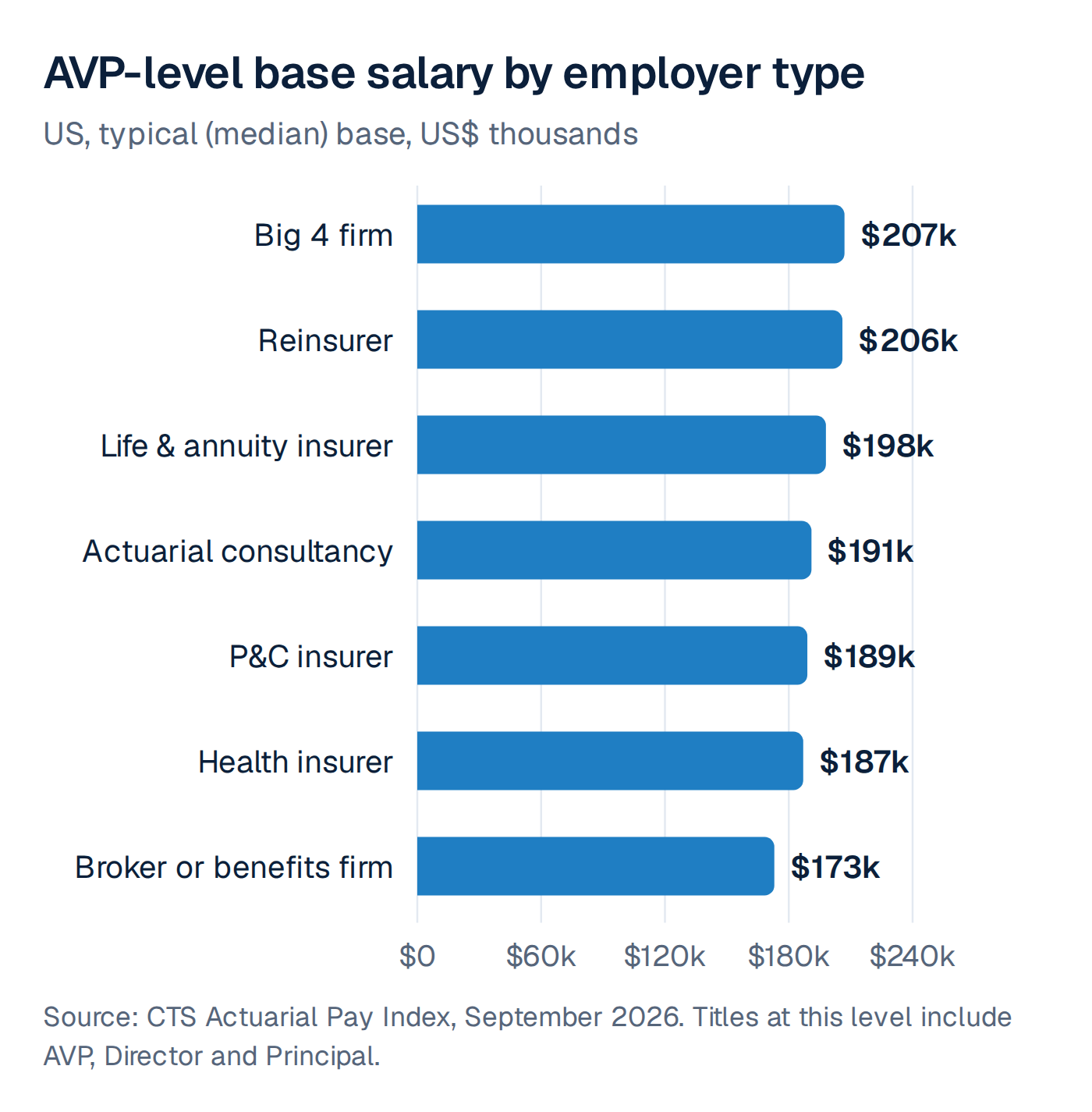
Typical AVP-level base by employer type in the US: Big 4 firms about $207,000, reinsurers about $206,000, life and annuity insurers about $198,000, actuarial consultancies about $191,000, P&C insurers about $189,000, health insurers about $187,000, and brokers and benefits consultancies about $173,000.
At actuary or manager level the order shifts. Big 4 firms pay about $188,000 and reinsurers about $180,000, then P&C insurers at $168,000, life and annuity insurers at $163,000, actuarial consultancies at $155,000, health insurers at $153,000, and brokers and benefits consultancies at $142,000. Bonus and long-term incentive structures differ a lot between these employers, so compare the whole package, not base alone.
Function matters too, a little
At actuary or manager level, pricing roles carry a typical base of about $168,000, risk and capital roles about $163,000, valuation and reporting roles about $160,000, and modelling and systems roles about $153,000. The differences are modest. The skills you build tend to matter more than the function label, especially as valuation and modelling work shifts under new rules such as VM-22.
What employers ask for at each level
Roles at each level also ask for a typical amount of experience and a credential:
- Analyst roles ask for a median of 2 years' experience.
- Associate-level roles ask for 4 years. About 70% require at least an Associateship (ASA or ACAS).
- Actuary or manager roles ask for 5 years. About 20% require a Fellowship, and about 65% require at least an Associateship.
- AVP or director roles ask for 8 years. About 35% require a Fellowship.
- VP roles ask for 10 years. About 30% require a Fellowship.
Two things stand out. First, a Fellowship is required in only about a third of AVP roles. Plenty of senior roles will consider a strong ASA or a candidate close to Fellowship, especially in pricing, modelling and consulting. Second, "years of experience" is a floor that employers bend for the right person. If you are a year short but have done the exact work, apply.
How to use this
- If you are moving between employer types, translate your level first, then your title. A Senior Consultant at a Big 4 firm moving to an insurer is usually looking at Associate Actuary or Actuary roles, depending on credentials and scope.
- If you are hiring, write titles that candidates will recognise and include the level in the description. A pay range helps more than any title.
- If you are negotiating, benchmark against the level and the employer type, not the title on your business card.
The Pay Index has a "By job title" view that does this translation for you. Pick your employer type and title, and it shows the typical range and what the same level pays elsewhere.
Sources and method
- CTS Actuarial Pay Index, job title view, October 2026: built from the pay ranges in the actuarial roles advertised from September 2025 to September 2026 and what we see in our own search work, with every figure reviewed by our team. Figures are the median and the lower and upper quartiles of base salary. For chief actuary roles we give the full span of base salaries instead.
About the author

Sho Temma is an Associate in Candidate Relations at Concordia Talent Solutions, a specialist actuarial and insurance recruitment firm. He works with actuaries across the US, Canada, Bermuda and Asia on their careers and next moves, and writes CTS Insights on actuarial pay, hiring and regulation.
More insights

What a move to Bermuda involves for actuaries: the work permit fast track, payroll tax and deductions, rents and schools, and your US or Canadian tax.

Typical base pay for US actuaries by credential, experience, sector and city, plus bonus targets and pay in Canada and Bermuda, from the CTS Pay Index.

What actuaries ask for to move, how counteroffers tend to play out, where non-competes still apply, and the paperwork for moving to the US or Bermuda.

Bermuda's long-term insurers hold $1.5 trillion of assets. How the market is growing, how the rules are tightening, and which actuarial skills it needs.
Let's talk about the role you can't fill
Whether you are hiring an actuary or quietly weighing up your next move, the first conversation is confidential and costs nothing.