
Moving to Bermuda as an actuary: permits, tax, housing and pay
What a move to Bermuda involves for actuaries: the work permit fast track, payroll tax and deductions, rents and schools, and your US or Canadian tax.
In short
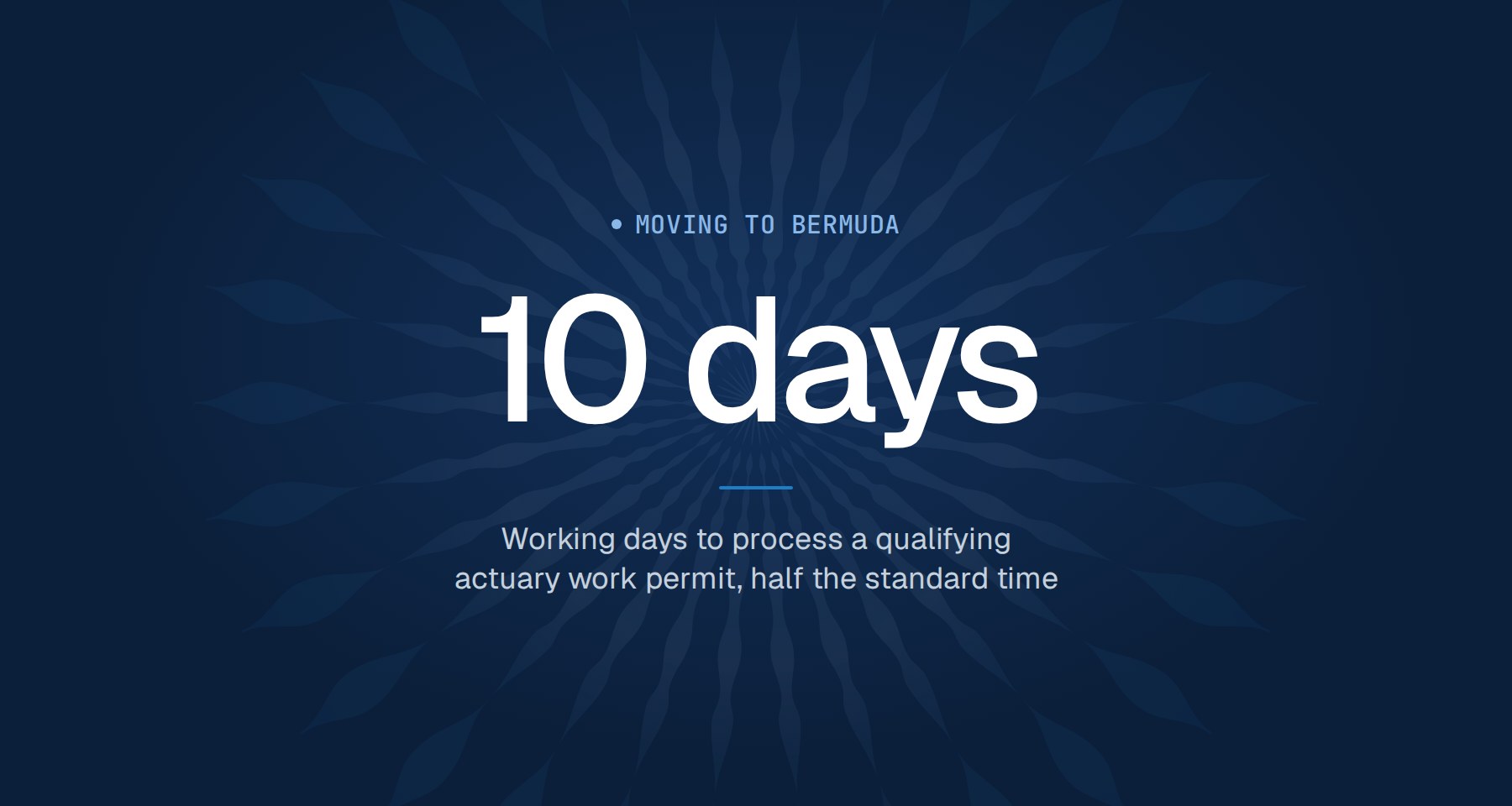
- Your employer applies for the work permit. The Government's policy is to process an actuary permit that meets its conditions within 10 working days, against 20 for a standard permit, and that fast track now runs to 31 July 2027.
- Bermuda has no personal income tax. Your employer may deduct the employee share of payroll tax (0.25% to 12.5% for 2026/27, on pay up to $1 million), a flat weekly social insurance contribution and up to half of the standard health insurance premium.
- Housing is the biggest cost. There are no official figures on typical rent levels, and local agents quote about $3,000 to $4,500 a month for a one-bedroom apartment and $8,000 to $15,000 or more for a family home.
- Moving does not end your tax life at home. US citizens stay taxable on worldwide income, and Canadians need to think about residency ties and departure tax before they go.
Bermuda comes up often in our conversations with life and annuity actuaries. The questions are nearly always the same: how long does the permit take, what will I take home, what does it cost to live there, and what happens to my tax at home? This guide puts the answers in one place, using the Government of Bermuda's own policy documents, laws and fee schedules wherever they exist.
For the market itself, who is hiring and why, see our piece on Bermuda life reinsurance. This one is about the move.
This guide is general information, not immigration, tax or legal advice. Rules and fees change, so check the current position with the Government of Bermuda and a qualified adviser before you act.
Why Bermuda hires actuaries from abroad
Bermuda's 2024 employment survey counted 370 actuary jobs on the island. Bermudians held 55 of them. Another 303, about 82%, were held by the group the statistics call "other non-Bermudians", which leaves out permanent residents and spouses of Bermudians. International business added 22 actuary jobs that year. The same survey puts the median gross income of full-time "other non-Bermudian" actuaries at $226,796, against $169,155 for all workers in international business.
The law also creates demand. Every long-term insurer in Bermuda must appoint an actuary approved by the Bermuda Monetary Authority, and the Insurance Act's definition of an actuary names members of the SOA, CIA, CAS, American Academy of Actuaries, IFoA and the Institute of Actuaries of Australia.
Work permits
How it works
- Your employer applies, not you. Standard permits are granted for one, two, three, four or five years.
- The role has to be advertised first: at least three times over eight days in a local newspaper, and for eight consecutive days on the Government Job Board, bermudajobconnect.bm.
- Intra-company transfers within a global employer skip advertising. If you have worked for the group for more than a year and earn a gross salary above $125,000, the transfer is approved automatically, as long as it does not fill an existing position.
- There is no term limit. Bermuda scrapped its six-year limit in 2013.
The actuary fast track
Section 7.14 of the Government's Work Permit Policy sets out a faster route for actuaries. It says a new permit will be processed within 10 working days, rather than the usual 20, where:
- the job description requires an actuary or a professional actuarial designation;
- you have at least three years' relevant professional experience;
- the position was advertised and the application is complete;
- the position does not need to go to a statutory body; and
- your employer supplies proof of your credentials.
The section is unchanged in the latest revision of the policy, dated 1 May 2026, and the Department of Immigration announced on 3 August 2026 that it has been extended to 31 July 2027. It covers new permits, not promotions or title changes, and your employer has to email the Department when it submits the application for the faster timeline to apply. The Minister has said the next round of policy changes is due in October 2026, so check the current version before you rely on any detail here.
What it costs your employer
Government fees for a standard permit are $1,015 for one year, $2,530 for two, $3,795 for three, $5,040 for four and $6,510 for five. Adding a sponsored dependant to a permit costs $275 each. Ask whether your employer pays these.
Rules that changed in 2025 and 2026
- English test. Since November 2025 new standard permit applicants have needed a minimum English test score, and since May 2026 most permit types do. Nationals of the English-speaking countries listed in the policy are exempt, as is anyone whose degree or professional qualification was completed in English. It mainly affects candidates from other countries who did not study in English.
- Changing jobs. Plan on two years with your first Bermuda employer. Until then you need the Department's permission to look for another job, and the policy says it will not normally be given. Once a new permit is issued, a job change will not be considered for six months (three months after a renewal), down from a year (six months) under the November 2025 policy. Promotions also need written permission and will not be considered in the first year of a new permit.
- Visiting while you wait. A November 2025 rule stopped applicants visiting Bermuda while their application was pending. The May 2026 update allows it again.
Bringing your family
- Spouses and partners, including unmarried partners, can be given permission to reside and seek work. To take a job, a spouse needs their own work permit, applied for by their employer in the usual way.
- Household income. To bring a spouse, your base salary must be at least $60,000. To sponsor dependants, it must be at least $60,000 for one dependant, $100,000 for two, $125,000 for three and $150,000 for four or more. Housing allowances, bonuses and school fees do not count. A married spouse is not counted as one of these dependants, but an unmarried partner is. You also need proof of medical cover.
- Children count as dependants until 18, or until 25 if they are in full-time college or university. They can live on the island but not work.
- Pets need an import permit, a microchip, two rabies vaccinations and a vet health certificate issued within 10 days of arrival. There is no quarantine facility, so an animal that fails inspection is sent back. Animals under 10 months old do not qualify.
Schools
Bermuda has several private schools. Published tuition for 2026/27:
- Saltus Grammar School: $27,820 a year, paid in one instalment, plus a $1,000 enrolment fee.
- Bermuda High School for Girls: $28,500 for Years 4 to 13.
- Somersfield Academy: $27,980 for secondary.
- Warwick Academy: $24,267, with exam and Sixth Form fees on top.
Public schooling is free, and under the Education Act 1996 school is compulsory from 5 until 18, or until a child graduates from senior school if that is earlier. We have not found an official statement on whether children of work permit holders can enrol, so check with your employer and the Department of Education before you plan around it. If school fees matter, ask whether the package contributes.
Tax and deductions: what you take home
No income tax, but payroll tax
Bermuda does not tax individuals' income. Instead, employers pay payroll tax and may deduct an employee share. The employee rates for 1 April 2026 to 31 March 2027 are:
- 0.25% on the first $48,000
- 7.75% from $48,000 to $96,000
- 10.75% from $96,000 to $200,000
- 11.5% from $200,000 to $500,000
- 12.5% from $500,000 to $1,000,000, with nothing above that
That works out at about $9,645 on a $150,000 salary and $20,770 on $250,000. Some employers pay the employee share themselves and list it as a benefit, so ask.
Social insurance, health and pension
- Social insurance is a flat weekly amount, not a percentage of pay. From 3 August 2026 the employee share is $39.25 a week, about $2,041 a year.
- Health insurance. Your employer must provide at least the Standard Health Benefit for you and for a married spouse who is not working. It can deduct no more than half of the standard premium, which is $439.55 a month from 1 April 2026. That caps the deduction at about $220 a month for each person covered. Plans vary above the minimum, so compare the cover, not only the deduction.
- Pension. Bermuda's occupational pension law currently covers Bermudians and their spouses, so work permit holders are not required to be enrolled. A 2019 amendment to extend it has not been brought into force. Some employers include non-Bermudians anyway, and US citizens should ask whether they can stay in a US plan.
A worked example
Take the Bermuda Government's latest median gross income for full-time "other non-Bermudian" actuaries, $226,796 (2024 employment survey). If the employer deducts the full employee share of payroll tax and the maximum health deduction for you alone, the deductions come to roughly:
- payroll tax: about $18,100
- social insurance: about $2,041
- health insurance: about $2,637
That is about $22,800 in total, leaving roughly $204,000 before housing, and before any tax you still owe at home. Payroll tax applies to bonuses as well as salary. A housing allowance, if offered, sits on top. For a figure closer to your own level, the Pay Index shows Bermuda base pay by credential, experience and employer type.
Tax at home
US citizens
The US taxes its citizens on worldwide income wherever they live, so you keep filing a US return. Two reliefs do most of the work:
- The foreign earned income exclusion is $132,900 for 2026. You qualify through bona fide residence abroad for a full tax year, or by being physically present abroad for 330 full days in any 12 months, and you have to file a return to claim it.
- The foreign housing exclusion has a Bermuda-specific limit of $90,000 for 2026, well above the general cap, because housing costs are so high. The exclusion covers qualifying housing costs above a base amount of $21,264, so the most you can exclude is about $68,700.
How these interact with a housing allowance, a US pension plan and state tax depends on your situation, so talk to a cross-border tax adviser before you sign.
Canadians
Canada taxes on residence, not citizenship, and whether you stop being resident depends on the ties you keep. A home, a spouse or partner, or dependants left in Canada can keep you resident. When you do become non-resident, certain property is treated as sold at market value on the day you leave. That is the departure tax, although Canadian real estate and registered plans such as RRSPs are excluded. You can apply to defer payment. Canada and Bermuda have a tax information exchange agreement. Again, get advice before you move.
Housing
Renting
Renting is the straightforward option on a work permit, and a lease of up to five years is fine for a non-Bermudian. There are no official figures on typical rent levels, and private sources differ. Published figures:
- The Property Group's 2026 guide quotes $3,000 to $4,500 a month for a one-bedroom apartment, $4,500 to $7,500 for a two-bedroom condo and $8,000 to $15,000 or more for a family home.
- Cranfields Property quoted $3,500 to $4,500 for one-bedroom condos in April 2025, when only 67 rentals were available island-wide.
- The rent component of the consumer price index rose 1.3% in the year to March 2026, although it covers existing tenancies and may understate rents on new lets.
Expect to pay the first month's rent and a deposit of one month's rent up front, plus a share of stamp duty on the lease.
Buying
Non-Bermudians need a licence to buy, and can only buy the top end of the market: houses with an annual rental value of at least $126,000 and condominiums of at least $25,800. On top of the price there is a licence charge of 12.5% of the value for a house or 8% for a condo. That is why most people on a first permit rent.
Housing allowances
In the offers we see, insurers and reinsurers usually include one, typically about $2,000 to $6,000 a month, while consulting firms usually do not. We have not found a published survey of how common they are in insurance. If a package includes one, ask how it is paid and how it is treated for tax at home.
Cost of living
- Prices. Consumer prices rose 2.4% in the year to March 2026. The US State Department pays staff posted to Bermuda a cost-of-living allowance worth 80% of their spendable income, housing aside, one of the highest rates it sets anywhere.
- Electricity is expensive. BELCO's residential energy charge runs from about 14.5 to 39.5 cents per kWh depending on how much you use, plus a fuel adjustment that BELCO resets every quarter (it was about 14.2 cents per kWh for July to September 2026, so check the current rate) and a monthly facilities charge.
- Getting around. Each household can register one private car. A Bermuda driving licence means a written exam and a road test, and we have not found an official route for exchanging a foreign licence. A monthly pass covering buses and ferries costs $69.
Practicalities
- Currency. The Bermuda dollar is pegged one to one to the US dollar, and US cash is accepted everywhere.
- Time zone. Bermuda is one hour ahead of New York and Toronto all year.
- Flights. Non-stop flights take about two hours from New York, under three from Toronto and under seven from London.
- Banking. The main banks are HSBC Bank of Bermuda, Butterfield and Clarien. HSBC accepts a work permit or employer letter as proof of your tie to the island, and the minimum opening deposit is $100.
- Healthcare. King Edward VII Memorial Hospital is the island's main hospital, and your care there is paid for mainly through your employer-provided health insurance.
Questions to ask before you accept
When we help actuaries weigh a Bermuda offer, these are the questions that most often change the answer:
- Is there a housing allowance, and how is it paid?
- Does the employer pay the employee share of payroll tax?
- What health cover do you get, what is deducted, and is your spouse covered?
- Is there a pension contribution, or a way to keep contributing to your home plan?
- How long is the permit, and who pays the fees and your relocation?
- If your partner wants to work, will the employer help, and would the household income cover your dependants?
- Is there help with school fees, and have you checked availability for your children's year groups?
Compare the whole package against your current pay after tax at home, not base salary against base salary. The Pay Index shows Bermuda pay by credential, experience and employer type, alongside the Government's figure and US and Canadian pay, and we are happy to talk through a specific offer, confidentially and at no cost. Email us to start.
Sources
- Government of Bermuda, Government Extends Actuary Work Permit Policy Until July 2027, 3 August 2026.
- Government of Bermuda, Work Permit Policy 2026: what you need to know, May 2026, and the Work Permit Policy revised 1 May 2026 (sections 1.1, 1.8, 1.10, 1.13, 3.3 to 3.5, 5.0 to 5.5 and 7.14, and Appendices I and II); Updates to the 2025 Work Permit Policy, 1 May 2026; English language proficiency requirements.
- Royal Gazette, Actuary work permit policy extended, 30 July 2026; Bernews, 1 August 2026.
- Government Fees Regulations 1976, Head 6; Government of Bermuda, immigration fees.
- Bernews, Government Eliminates Term Limit Policy, January 2013.
- Government of Bermuda, 2025 Employment Briefs (2024 Employment Survey); Insurance Act 1978, sections 1 and 26.
- Saltus, Bermuda High School, Somersfield Academy and Warwick Academy fee schedules for 2026/27; Government of Bermuda, public school system; importing a dog or cat.
- PwC Worldwide Tax Summaries, Bermuda: taxes on personal income, February 2026; Government of Bermuda, Calculating Payroll Tax 2026.
- Department of Social Insurance, contribution calendar (from 3 August 2026); Health Insurance Act 1970, sections 20 to 23; standard premium rate, March 2026; National Pension Scheme (Occupational Pensions) Act 1998; Carey Olsen on occupational pensions, April 2024.
- IRS, US citizens and resident aliens abroad; IRS Notice 2026-25; IRS, foreign earned income exclusion.
- Canada Revenue Agency, determining your residency status; dispositions of property on leaving Canada; Finance Canada, Canada-Bermuda tax information exchange agreement.
- The Property Group, rents in Bermuda, 2026; Cranfields Property, market update, April 2025; Coldwell Banker Bermuda, renters' resources; Bermuda Immigration and Protection Act 1956, section 82; Minimum Annual Rental Values Regulations 2007; Land-Holding Charges Regulations 2007; Royal Gazette, Pay transparency legislation in the works, 14 April 2026.
- Government of Bermuda, Consumer Price Index, March 2026; US Department of State, cost-of-living allowances; BELCO, know your rate and bill; Motor Car Act 1951, section 16; how to get a driver's licence; public transport fares.
- US Consulate Hamilton, banking and currency; Bermuda Tourism Authority, getting to Bermuda; HSBC Bermuda, opening your first bank account; Bermuda Hospitals Board.
- Pay figures: Government of Bermuda, 2024 Employment Survey detailed tabulations, Table 26. Worked example deductions are our own arithmetic from the rates above. Bermuda pay by level: CTS Actuarial Pay Index.
About the author

Sho Temma is an Associate in Candidate Relations at Concordia Talent Solutions, a specialist actuarial and insurance recruitment firm. He works with actuaries across the US, Canada, Bermuda and Asia on their careers and next moves, and writes CTS Insights on actuarial pay, hiring and regulation.
More insights
Typical base pay for US actuaries by credential, experience, sector and city, plus bonus targets and pay in Canada and Bermuda, from the CTS Pay Index.
Titles mean different things at insurers, reinsurers, consultancies and Big 4 firms. How the levels line up and what each pays in the US, Canada and Bermuda.

What actuaries ask for to move, how counteroffers tend to play out, where non-competes still apply, and the paperwork for moving to the US or Bermuda.
Bermuda's long-term insurers hold $1.5 trillion of assets. How the market is growing, how the rules are tightening, and which actuarial skills it needs.
Let's talk about the role you can't fill
Whether you are hiring an actuary or quietly weighing up your next move, the first conversation is confidential and costs nothing.